 تويت
 Multi-Zone Wireless Temperature and Humidity Telemetry Networks
Maintaining an unbroken cold chain across the Arabian Gulf represents one of the most demanding operational challenges in food logistics, pharmaceutical distribution, and floral transport. Ambient summer temperatures exceeding 50°C create extreme thermal gradients between internal refrigerated trailer bodies (reefers) and external environments. A temperature excursion lasting as little as fifteen minutes can ruin high-value pharmaceutical cargo, invalidate regulatory compliance certificates, or lead to massive food spoilage losses. Achieving uncompromising cold chain integrity requires smart fleet management platforms integrating continuous multi-zone thermal sensors, automated reefer controller telemetry, and rapid escalation protocols.
Relying on single-point reefer discharge temperature displays provides a false sense of security. Temperature distribution within a 53-foot refrigerated trailer varies significantly due to cargo loading patterns, air pallet spacing, and door opening cycles. Eagle Fleet management system in Kuwait Inadequate airflow creates localized heat pockets near the rear trailer doors where temperatures can rise by 6°C to 10°C above setpoint while the main discharge sensor records acceptable readings.
Smart cold chain monitoring systems utilize wireless BLE (Bluetooth Low Energy) or wired RS485 probe arrays positioned at critical zones throughout the cargo compartment: supply air, return air, front bulkhead, mid-trailer, and rear door discharge points. These sensors sample temperature and relative humidity levels every 30 seconds with NIST-traceable accuracy of ±0.2°C. Sensor data streams wirelessly to the vehicle's telematics gateway, continuously plotting spatial thermal maps of the cargo volume. If any sensor detects a drift outside pre-approved HACCP thermal bounds (e.g., 2°C to 8°C for biologics), emergency notifications trigger instantly.
Direct Reefer Controller Integration and Remote Control Capability
Advanced cold chain tracking extends far beyond passive temperature recording; it provides bi-directional command and telemetry integration with leading refrigeration units (such as Thermo King and Carrier Transicold). The telematics terminal interfaces directly with the reefer microprocessor via serial communication protocols, pulling real-time operational data including engine run hours, compressor discharge pressure, electric standby status, alarm codes, and fuel level.
Fleet dispatchers gain remote command capabilities directly through the centralized web dashboard. In the event an operator accidentally sets a reefer controller to continuous run mode instead of cycle-sentry mode—or enters an incorrect setpoint temperature (e.g., setting -18°C for fresh produce requiring +4°C)—cold chain managers can remotely modify setpoints, clear minor fault codes, or switch operating modes without requiring the driver to pull over. This real-time bi-directional control prevents catastrophic cargo freezing or defrost failures caused by human operator error.
Quantifiable Financial Metrics and Operations Engineering ROI
Deploying an enterprise telematics platform requires a clear financial justification based on measurable return on investment. Organizations using the Eagle Tracking system across heavy power and construction operations achieve quantifiable efficiency gains across four key performance metrics:
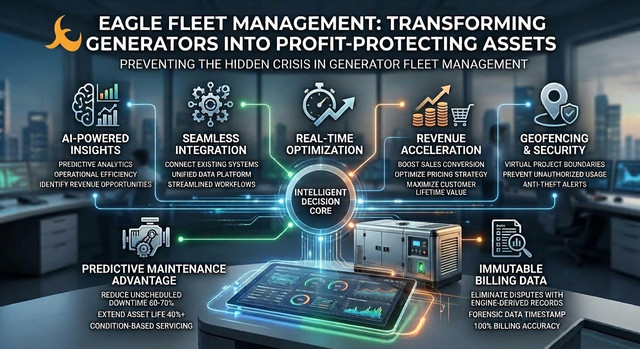
Implementing Eagle Tracking transforms heavy power assets into connected, intelligent machinery, delivering lower operating costs, maximum uptime, and total operational control across Kuwait, the Middle East, and global operations.
Relying on single-point reefer discharge temperature displays provides a false sense of security. Temperature distribution within a 53-foot refrigerated trailer varies significantly due to cargo loading patterns, air pallet spacing, and door opening cycles. Eagle Fleet management system in Kuwait Inadequate airflow creates localized heat pockets near the rear trailer doors where temperatures can rise by 6°C to 10°C above setpoint while the main discharge sensor records acceptable readings.
Smart cold chain monitoring systems utilize wireless BLE (Bluetooth Low Energy) or wired RS485 probe arrays positioned at critical zones throughout the cargo compartment: supply air, return air, front bulkhead, mid-trailer, and rear door discharge points. These sensors sample temperature and relative humidity levels every 30 seconds with NIST-traceable accuracy of ±0.2°C. Sensor data streams wirelessly to the vehicle's telematics gateway, continuously plotting spatial thermal maps of the cargo volume. If any sensor detects a drift outside pre-approved HACCP thermal bounds (e.g., 2°C to 8°C for biologics), emergency notifications trigger instantly.
Direct Reefer Controller Integration and Remote Control Capability
Advanced cold chain tracking extends far beyond passive temperature recording; it provides bi-directional command and telemetry integration with leading refrigeration units (such as Thermo King and Carrier Transicold). The telematics terminal interfaces directly with the reefer microprocessor via serial communication protocols, pulling real-time operational data including engine run hours, compressor discharge pressure, electric standby status, alarm codes, and fuel level.
Fleet dispatchers gain remote command capabilities directly through the centralized web dashboard. In the event an operator accidentally sets a reefer controller to continuous run mode instead of cycle-sentry mode—or enters an incorrect setpoint temperature (e.g., setting -18°C for fresh produce requiring +4°C)—cold chain managers can remotely modify setpoints, clear minor fault codes, or switch operating modes without requiring the driver to pull over. This real-time bi-directional control prevents catastrophic cargo freezing or defrost failures caused by human operator error.
Quantifiable Financial Metrics and Operations Engineering ROI
Deploying an enterprise telematics platform requires a clear financial justification based on measurable return on investment. Organizations using the Eagle Tracking system across heavy power and construction operations achieve quantifiable efficiency gains across four key performance metrics:
- 22% Reduction in Fuel Expenditure: Achieved by eliminating fuel theft via instant ultrasonic level alarms, identifying and stopping unproductive engine idling, and optimizing running load profiles to keep engines operating within their peak efficiency bands.
- 35% Reduction in Unbilled Engine Runtime: Rental equipment providers often face unbilled usage when clients run machinery beyond contracted hours. Continuous CAN-bus tracking logs exact engine start and stop timestamps, generating automated, audit-proof billing records based on true run hours.
- Zero Unauthorized Machine Movements: Precise polygon geofencing combined with automated starter Solenoid Lockout relays ensures assets remain within authorized site boundaries. If an asset is moved without authorization, automated security commands disable starting systems, preventing asset loss.
- Extended Overhaul Intervals (6,000 to 8,500+ Hours): Transitioning from arbitrary calendar servicing to load-indexed predictive maintenance prevents engines from operating with degraded lubricants or clogged cooling cores. Maintaining clean fuel supply lines, balanced phase loads, and optimal operating temperatures extends overall engine life, delaying costly engine overhauls by thousands of operating hours.
Implementing Eagle Tracking transforms heavy power assets into connected, intelligent machinery, delivering lower operating costs, maximum uptime, and total operational control across Kuwait, the Middle East, and global operations.