 تويت
 The Gap Between Owning Vehicles and Knowing Them
Every few months I walk into a yard in Shuaiba or Sohar and ask a simple question: how many of your units are moving right now? The answer usually arrives after three phone calls and a guess. That delay is the real cost of an unmanaged fleet. Fuel, tyres and drivers all appear on an invoice somewhere, but the hours lost to not knowing never reach any ledger. Cutting-edge fleet management starts by closing that gap, using hardware smaller than a deck of cards and software that fits on one screen.
For owners across Kuwait and the wider North African corridor, the stakes have shifted. Fleets now cross borders, subcontract trailers, rent excavators by the week and run drivers across three shifts. A system that only draws dots on a map cannot keep pace with that. What the market needs is a platform that reads the machine, the driver and the cargo together, and Eagle Tracking was built around exactly that idea.
What Cutting-Edge Actually Means on the Ground
The phrase gets stretched by marketers, so let me anchor it to specifications. A modern tracking unit samples position every one to five seconds while moving, reads the vehicle's CAN bus for engine speed, coolant temperature, fuel rate and fault codes, and stores several days of data on board when the cellular signal drops. It carries a backup battery, raises a tamper alert if someone cuts its power, and uses a multi-band modem able to roam across carriers from Kuwait to Egypt without a SIM swap. If a unit cannot do these things, it is a locator, not a fleet system.
Eagle In-Vehicle Monitoring System (IVMS) software side matters just as much. Data should reach the dashboard within seconds, be searchable by plate, driver or asset tag, and be replay able second by second for any trip in the past year. Cutting-edge also means open. An API lets your ERP, fuel card provider or customer portal draw from the same source, so nobody retypes figures at month end.
One Platform, Seven Working Systems
Fleet owners often discover they are paying for several disconnected tools: a tracker from one vendor, a fuel sensor from another, a maintenance spreadsheet, a dashcam subscription. Eagle Tracking folds seven systems into a single platform, and the value lies in how they feed each other.
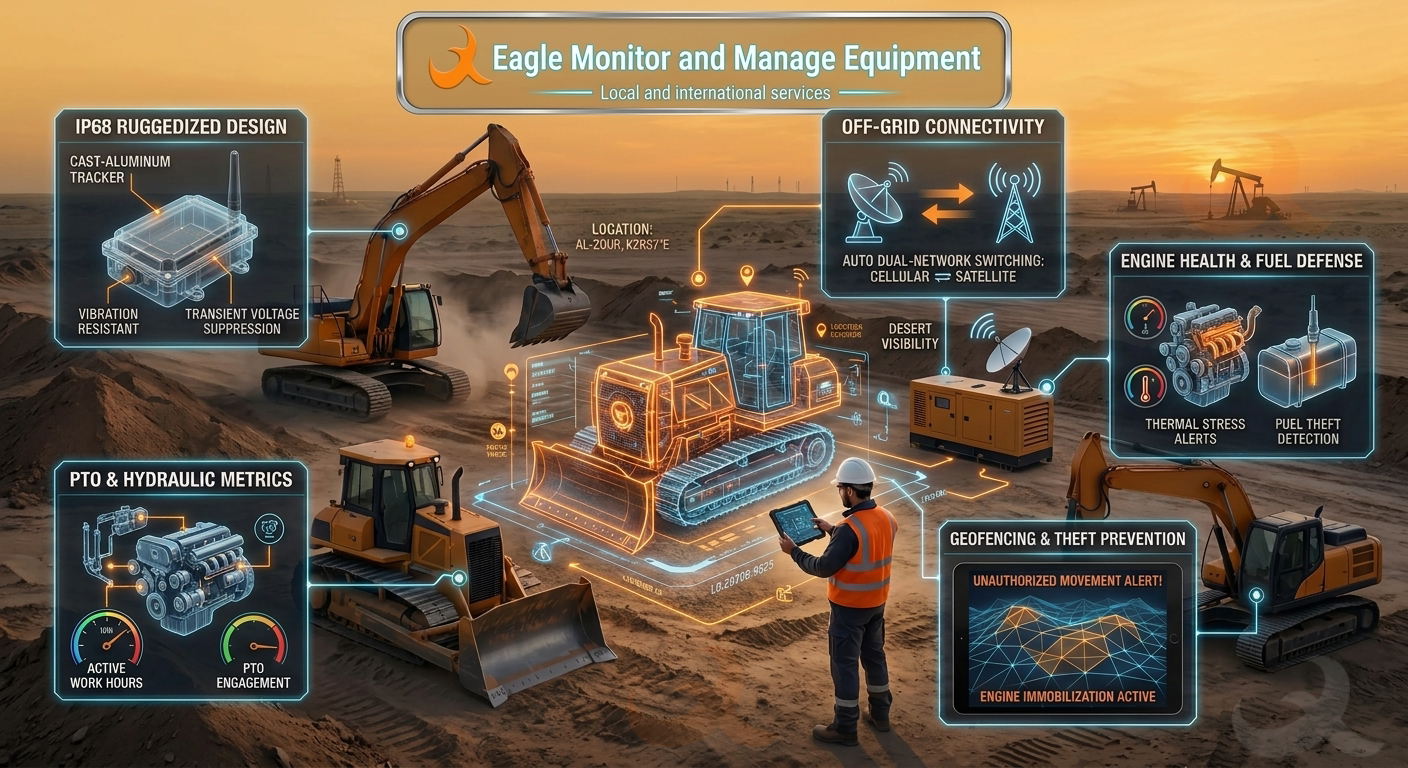
Live tracking and geofencing show where every unit is and when it crosses a boundary. Fuel monitoring reads tank probes and flow data to expose theft and waste. Driver behavior and video capture harsh braking, speeding and distraction with footage attached. Maintenance management turns engine hours and kilometres into service schedules. Heavy equipment telematics follows idling, working hours, power take-off and hydraulic use. Sensor integration covers cargo temperature, door status and trailer coupling. Route planning and reporting assign jobs, measure delivery windows and produce the numbers a CFO actually reads.
Picture a fuel drop recorded at 2 a.m. beside a geofence near a closed depot, with the driver's ignition card swiped minutes earlier. Nobody needs to guess. The platform assembles the story from three systems at once. That is the difference between seven tools and one system.
Surviving the Kuwaiti Summer and the Desert Road
Hardware that behaves well in Frankfurt does not automatically behave well in Jahra in July. Cabin temperatures in parked vehicles climb past 70 degrees Celsius, and dust finds every seam. Units specified for fleets here should offer an operating range of at least minus 30 to plus 85 degrees, sealed housings, and industrial-grade power cells that tolerate heat better than standard lithium packs. I have pulled consumer-grade trackers out of pickups after a single summer, casings warped and batteries swollen. Specifying properly once costs far less than replacing devices every season.
Connectivity deserves the same respect. Along the Alexandria to Marsa Matruh road, or the long Libyan coastal stretches, coverage comes and goes. Store-and-forward memory means a four-hour dead zone leaves no hole in the trip record. When the unit reconnects it uploads every buffered point in sequence, and the route redraws itself in full.