 تويت
تويت
 Eagle GPS Tracking: The Foundation Everything Else Sits On
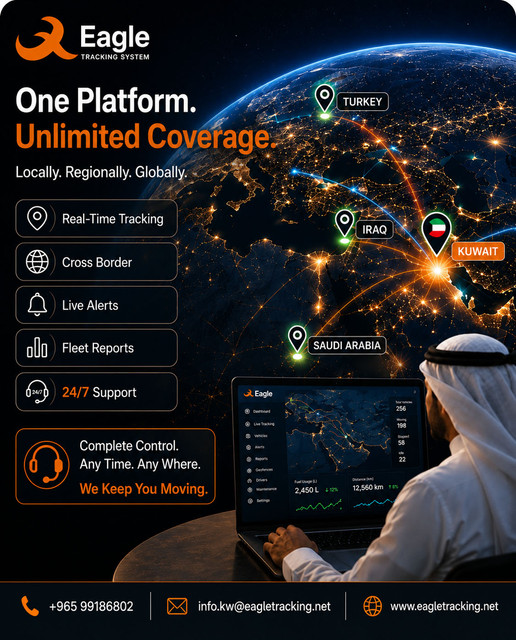
Every fleet owner eventually reaches the same uncomfortable realization. The trucks are tracked by one tool, the drivers are evaluated by another, fuel gets reconciled through a spreadsheet nobody trusts completely, and the refrigerated cargo relies on a reefer unit's own word that it did its job. Each piece works, more or less, in isolation. What none of these fragmented tools provide is the single, coherent view a fleet director actually needs to run a serious transport or equipment business in Kuwait, across the Gulf, or into North Africa. Eagle Tracking was built to solve exactly that gap, not by adding one more screen to an already crowded desk, but by pulling seven distinct monitoring disciplines into a single platform that speaks with one voice. What follows is a walk through each of those seven systems and what they mean for a company serious about protecting its fleet, its margins, and its reputation.
Eagle GPS Tracking: The Foundation Everything Else Sits On
Positional visibility is where fleet management always begins, and in this region it demands more than a satellite pin that updates every few minutes. Kuwait's climate alone, with summer temperatures routinely above fifty degrees Celsius, punishes hardware not engineered for it, and coverage gaps along desert corridors between cities have historically caused tracking data to disappear at the exact moments a fleet director needed it most. Eagle's vehicle tracking system for fleet in Kuwait layer addresses both problems directly. Devices are selected for thermal resilience and sealed against sand infiltration, and the system buffers positional data locally whenever a cellular signal drops, transmitting the full route the instant connectivity returns. Custom geofences around depots, customer sites, and restricted zones turn a raw coordinate into something genuinely useful, an automatic classification of every stop a vehicle makes, so a truck that drifts off its assigned corridor near Sulaibiya triggers a dispatcher alert before the driver himself has noticed the detour. This foundation is what every other Eagle module builds on top of, because behavior, speed, temperature, and fuel data mean far more once they are tied to an exact, reliable position on the map.
Eagle International Vehicle Tracking: Following the Fleet Past the Border
Companies rarely stay confined to one country for long, and the moment a fleet starts crossing into Saudi Arabia, Iraq, or across North African borders, most tracking tools begin to fragment. Different carriers, different customs procedures, and historically, a break in the data trail at every crossing. Eagle's international layer uses multi carrier connectivity so a single unit roams seamlessly between national networks, producing one continuous trip record rather than several disconnected fragments a back office team has to stitch together manually. For rental companies moving heavy equipment across borders mid project, this continuity resolves a recurring source of disputes, since an unbroken digital record of exactly where a crane or an excavator has been removes the ambiguity from late return or damage claims regardless of which country's network carried the signal that day. A regional operations director overseeing fleets across three or four countries opens the same dashboard every morning and sees the entire footprint, not a patchwork of local systems that each speak a different language.
Eagle Fleet Management: Turning Assets Into a Coordinated System
Positional and cross border visibility answer where a vehicle is. Fleet management answers what condition it is in and what it is costing the company. Most mid sized operators still run maintenance schedules on rough intervals and reconstruct per vehicle costs manually at year end, which means a truck quietly consuming disproportionate maintenance spend relative to its contribution stays invisible inside an aggregate budget for months. Eagle tracks usage against manufacturer service intervals automatically, flagging vehicles approaching a threshold with enough lead time to schedule service before a breakdown forces the issue. For heavy equipment, the same logic applies to engine hours rather than distance, correctly distinguishing a generator running continuously on a site from a truck accumulating kilometers on the highway. The result is a per asset cost profile that updates continuously, giving ownership a defensible answer the moment someone asks what a specific vehicle actually costs the company each month, rather than a rough estimate pieced together from old fuel receipts.
For company owners weighing the investment, the calculation tends to become clear quickly. The cost of a single serious incident, a rejected pharmaceutical shipment, a preventable accident, an unnoticed fuel leak repeated across dozens of vehicles for months, routinely exceeds the cost of the platform that would have caught it early. Eagle Tracking was built on the conviction that a fleet's biggest risks and its biggest savings both live in the same place: in data that nobody was consolidating properly before. Bringing seven disciplines together under one platform does not just save a fleet director time each morning. It changes the nature of the decisions a company is able to make, replacing habit and assumption with a record that can be trusted, defended, and acted on the moment it matters.
Eagle GPS Tracking: The Foundation Everything Else Sits On
Positional visibility is where fleet management always begins, and in this region it demands more than a satellite pin that updates every few minutes. Kuwait's climate alone, with summer temperatures routinely above fifty degrees Celsius, punishes hardware not engineered for it, and coverage gaps along desert corridors between cities have historically caused tracking data to disappear at the exact moments a fleet director needed it most. Eagle's vehicle tracking system for fleet in Kuwait layer addresses both problems directly. Devices are selected for thermal resilience and sealed against sand infiltration, and the system buffers positional data locally whenever a cellular signal drops, transmitting the full route the instant connectivity returns. Custom geofences around depots, customer sites, and restricted zones turn a raw coordinate into something genuinely useful, an automatic classification of every stop a vehicle makes, so a truck that drifts off its assigned corridor near Sulaibiya triggers a dispatcher alert before the driver himself has noticed the detour. This foundation is what every other Eagle module builds on top of, because behavior, speed, temperature, and fuel data mean far more once they are tied to an exact, reliable position on the map.
Eagle International Vehicle Tracking: Following the Fleet Past the Border
Companies rarely stay confined to one country for long, and the moment a fleet starts crossing into Saudi Arabia, Iraq, or across North African borders, most tracking tools begin to fragment. Different carriers, different customs procedures, and historically, a break in the data trail at every crossing. Eagle's international layer uses multi carrier connectivity so a single unit roams seamlessly between national networks, producing one continuous trip record rather than several disconnected fragments a back office team has to stitch together manually. For rental companies moving heavy equipment across borders mid project, this continuity resolves a recurring source of disputes, since an unbroken digital record of exactly where a crane or an excavator has been removes the ambiguity from late return or damage claims regardless of which country's network carried the signal that day. A regional operations director overseeing fleets across three or four countries opens the same dashboard every morning and sees the entire footprint, not a patchwork of local systems that each speak a different language.
Eagle Fleet Management: Turning Assets Into a Coordinated System
Positional and cross border visibility answer where a vehicle is. Fleet management answers what condition it is in and what it is costing the company. Most mid sized operators still run maintenance schedules on rough intervals and reconstruct per vehicle costs manually at year end, which means a truck quietly consuming disproportionate maintenance spend relative to its contribution stays invisible inside an aggregate budget for months. Eagle tracks usage against manufacturer service intervals automatically, flagging vehicles approaching a threshold with enough lead time to schedule service before a breakdown forces the issue. For heavy equipment, the same logic applies to engine hours rather than distance, correctly distinguishing a generator running continuously on a site from a truck accumulating kilometers on the highway. The result is a per asset cost profile that updates continuously, giving ownership a defensible answer the moment someone asks what a specific vehicle actually costs the company each month, rather than a rough estimate pieced together from old fuel receipts.
For company owners weighing the investment, the calculation tends to become clear quickly. The cost of a single serious incident, a rejected pharmaceutical shipment, a preventable accident, an unnoticed fuel leak repeated across dozens of vehicles for months, routinely exceeds the cost of the platform that would have caught it early. Eagle Tracking was built on the conviction that a fleet's biggest risks and its biggest savings both live in the same place: in data that nobody was consolidating properly before. Bringing seven disciplines together under one platform does not just save a fleet director time each morning. It changes the nature of the decisions a company is able to make, replacing habit and assumption with a record that can be trusted, defended, and acted on the moment it matters.